There is only a narrow line between madness and courage, and it is also so far removed from everyday reality. My friend Ilja Zachoval ignored this life retardation in a completely natural way. Moreover, he was able to spread such a philosophy around him, in a completely irresistible and contagious way. It is no wonder that it was he who was at the origin of a whole series of ideas that were crazy at first glance and practically impossible to implement, but which always touched and fulfilled our wonderful boyhood dreams and plans. I was also lucky enough to be exposed to the influence of this exceptional man for a long time, whose nature clearly did not fit into the "common domestic standard". And so, like many others, I succumbed to his irresistible conviction under his influence: "...why wouldn't it be possible?" Or I let the all-solving person dispel my fears: "Stop talking and let's get to it." All this was supported by his direct and absolutely unambiguous actions and expressions, which he probably had thanks to the fact that he was genetically half a Nordic, and on the other hand, a non-conformist easy-going approach to life, which could have been due to a quarter of French blood. As he was artistically gifted and academically educated, he chose iron for his work and with most of the money he ever received for his truly artistically high-quality works, he bought technical gems for his home in the form of old motorbikes, mostly racing ones. When I say home, it is not accurate, because as he said: "A motorbike is supposed to ride," and he always did so, often with incredible and even admirable stubbornness (probably thanks to his Viking ancestors).
I went to visit Ilja one spring, I think sometime in 2001, to see what he was planning for the new racing season, to chat, to take a break from the "normal world" and work, and to get some inspiration. It's like there's a point to doing things that seem completely irrational, but the important thing is that you enjoy it. The forge in Šléglov, where Ilja lived and worked with his family, was exceptional in this respect and the atmosphere of the place was inimitable. An old stone house, the smell of a forge. There's no rush and everything around really looks and feels like time has stopped there, or rather runs at a completely different pace and according to different rules. Strange and calming. These visits were always a holiday for me. The door was always open and I never came at a disadvantage. When Ilja had just melted the furnace, I grabbed a hammer and the work was finished first. Then we chatted long into the night, or rather until dawn. I went there at that time also with the feeling that I was slightly tempted to get something new – better, after years spent in the saddle of a single-cylinder Eso. I meditated on various options, which Ilja soon put an end to, saying that in his opinion only a four-cylinder from Strakonice made sense. It is the pinnacle of what has been created in this field in our country. So what else?
I thought it was a good joke. The production of such a replica in our conditions could probably be compared to an attempt to produce a space shuttle in the Jeseník Regional Services Company. I laughed and ironically added a well-known quip: „Only those with small goals are small.“ The blacksmith got up from the table without a word, went to the attic and after a while returned and unrolled a drawing across the kitchen table. It was a drawing of an engine. The corner stamp read ČZ 500 – 4V, Pudil drew. He stuffed his pipe, smiled under his beard and watched me with amusement. I watched it with complete fascination, as if a meteorite had just fallen into the middle of the kitchen. It is worth noting that the development of the following events was not far from such an unreal event in its effect. With my mouth still open, I then listened to Ilya’s story about how he came up with that drawing.
Actually, it all started sometime in the late 1970s and early 1980s, when a few old-bike enthusiasts organized a demonstration ride of historic racing motorcycles at the Czechoslovakian Grand Prix in Brno. Even then, it became clear that the participants had a strong sense of competitiveness, when, despite the organizers' instructions about a planned gradual start, they took the organization into their own hands and at the first wave of the starter's flag, intended only for the first row, the entire starting field took to the track. Nobody wanted to be left behind! The start went smoothly, the starter saved himself by jumping into a ditch, and a whole horde of wild veterans stormed the race, which had absolutely nothing to do with a demonstration ride. After this memorable weekend, the veteran virus began to spread throughout the Czech Republic. In communist Czechoslovakia, however, only Svazarm was introduced in this field, within which, fortunately, at least veteran clubs operated, in which motorcycle fans could associate. It was in their bosom that a clique began to form, which subsequently came up with the idea of returning beautiful historic racing motorcycles to the racing tracks. However, there were not many options for rides, or rather, none. Only historic motorcycle races were organized, or more precisely, veteran rallies, which were events that, in terms of their organization, corresponded to the profile of the organizing organization, i.e. the Association for Cooperation with the Army (Svazarm). Even though some kind of circuit was already organized, it was impossible to skip the performance of military-oriented disciplines, such as throwing a grenade at a target. You will certainly admit that such an interrupted ride did not fill anyone with enthusiasm. Road racing was a downtrodden nightmare at the time, with various single-cylinder Svazarmov bikes being used, and only the biggest guys managed to get hold of the older twin-cylinder that had been abandoned. These were exclusively motorcycles with two-stroke engines. The soundscape of the races at that time was like a pack of brushcutters rushing past you. It was Ilja Zachoval and his friend Vraťa Hromádko who were the first to dust off and renovate their beautiful old four-stroke racing Jawa 2xOHCs and seize the first opportunity to truly be a man – they entered a regular road motorcycle race. Only a few older witnesses in the depot knew what it was about. Otherwise, however, the two boys were ridiculed by the „real racers“, i.e. the participants in the Regional Championship C. They urged them to stay to the side, not to get in the way, and so on. It was a big stir. After a difficult start, both Jawas began to tear unstoppably forward through the field of riders. The wonderful roar of the spinning four-stroke twin-cylinder engines "opened the heavens" and it was the only thing that could be heard on the track. It was something that the local champions had never experienced before. The standard two-stroke sputtering came out of the Jawas' exhausts, not the standard two-stroke sputtering, but a powerful whirlwind of gases and deafening decibels. The sound effect had an effect on the opponents like a Hussite chant for Sigismund's mercenaries. When these roaring beasts rushed past them, they remained completely frozen. It was a real treat for both of them. Almost everyone came to see the Jawas, even the champions, whose faces still showed the delighted expression long after the race.
At the end of the season, both Ilja and Vraťa had qualified for promotion to the higher class and Vraťa was, I think, even first in the overall standings. That was a big word in the debate. The next year, more „restorers“ appeared and several more four-strokes were racing on the road circuits. Soon there were enough of them to create a separate category and thanks to Libor Kamenický, this category, called Classic, was included in the road racing program. Some champions felt outclassed (and rightly so) and the truth is that this class became the draw of all races, even in terms of spectators. I think that in the entire time that Classics has been running, there have not been many races where Ilja and his machines have been absent. He loved natural tracks above all, perhaps Hořice the most, and when we stood together on the deck of a ship with the Isle of Man disappearing behind its stern, he said that we must definitely return here, but not as a passenger, but as a racer and with a confirmed application in our pocket.
I apologize for this perhaps somewhat lengthy digression, but I thought it would be good to describe a little of the „persons and staff“, that is, what roughly preceded my spring visit in 2001. I am now returning to the Zachovalovice kitchen, where I am staring at the drawings of the ČZ 500 – 4V and listening to Ilja’s story. Everyone probably knows what level our racing motorcycles were at in the 1950s and 1960s. Czech factories employed really capable designers and our riders with domestic motorcycles held their own in the world championship tables. Our largest arms factory, ČZ in Strakonice, also employed a very high-quality cadre of designers. Alongside the old, experienced engine designer Mr. Walter, the young engineer Jaroslav Pudil grew up and developed his extraordinary talent. After a series of very successful single- and twin-cylinder motorcycles, with which ČZ achieved a great deal of success, the work of this team resulted in the design of a four-cylinder engine. Mr. Pudil was a truly exceptional personality who devoted absolutely everything to his work. In addition to his extraordinary technical talent, he proved to be a great visionary when he designed an original solution for a four-cylinder engine with a V-shaped arrangement for that time, which was several years ahead of his time. Thanks to this, the engine acquired compact dimensions with a small frontal area and a low center of gravity. The engine is full of original elements. Let's mention the clutch located behind the gearbox on the secondary gear. The first drawings are dated 1966. The engine and chassis were very intensively improved and the entire team worked with great commitment. The factory had probably the best that was available in our country at the time - multiple national champion Bohumil Staša. It is clear that the people from Strakonice had "stepped" very high. Gradually, the motorcycle was able to get going and the results started to come in. The competition had to watch our machine with great respect, especially when Staša came second with it in the Grand Prix of the Czechoslovak Socialist Republic in Brno, part of the world championship series. Now, several years of effort were about to start bringing success. However, it was 1971 and with the onset of normalization, our workers' and peasants' government of workers under the leadership of the Communist Party indicated that investment in this direction would not bring any prospects to our socialist establishment. Thus, the program of development and operation of road motorcycles at ČZ Strakonice was terminated. After all, it was not a mass sporting event for socialist athletes anyway. And the motorcycle as a means of transport for workers had also definitely been surpassed by the car. Moreover, this sport was mainly practiced in the western capitalist part of the globe, which from the party's point of view at the time was the wrong one. Both functional four-cylinders went to the company museum, and it was fortunate that they did not end up worse.
The people at the factory had motorbikes in their blood and found it difficult to accept the party's decision. The father of the whole project, Mr. Pudil, stayed on at the factory and worked on the design of mainly motocross motorbikes, but these were single-cylinder two-strokes and it was definitely not possible to compare them with the technology of the four-stroke four-cylinder that he had brought into the world. It was no wonder that such work did not satisfy him very much. He did at least have the opportunity to return to better work designing prototypes of touring road motorbikes, which the factory had, rather out of love for the cause, brought to a working prototype, but production never took place, and in fact it probably could not have. The designer Pudil never reconciled and did not come to terms with the fate that his comrades had prepared for his work, and the feeling of ruin accompanied him for a large part of his life. By the end of the 1980s, motorbike production in Strakonice was already in decline anyway, and with the fall of communism the market collapsed completely. At some point during that time, someone rang the doorbell at Pudil's Strakonice apartment. There were two of them. A smaller, curly-haired, eloquent man (Vraťa) and a slightly taller, black-haired man with round glasses, a pipe, dressed in overalls and a snake-like cap on his head (Ilya). Mr. Pudil quickly understood how kindred spirits they were, and even more so after they explained the purpose of their visit. They came to him with a rather fantastic idea and a request to see if he would help bring their four-cylinder motorcycle back into the world, which both enthusiasts were determined to reincarnate, and most importantly – to operate in a racing manner. This was, of course, music to Mr. Pudil's ears. The idea of hearing that unmistakable, beautiful sound of his engine again, of his work being realized again, would make sense...! It was evidently a seance of three fools and dreamers, but they decided to rebuild the motorcycle. This time, however, as a full-fledged half-liter! Factory bikes ended up with a capacity of 420 cm3, because at that time the original engine could not be re-bored to anything more. Mr. Pudil saw an opportunity to finish his work. Simply what he had not managed to do in the factory. He actually already had a 500 cm3 engine ready in his head and partly on the drawing board. The deal was clear. A development successor to the factory bike would be built, but for the 500 class.
So I stared in disbelief at these drawings in the blacksmith's kitchen. After the coup, however, much changed, and some of us left the friendly havens of safety of socialist enterprises and set out on the path of building our own capitalism. That's what Vraťa and I did at that time. However, because there were several years in the beginning when we had to exploit ourselves quite intensively, there was no time or money left for "nonsense". For Ilja, as a free artist, not much changed, except that he had to fight for the realization of his designs with newly born private investors instead of with the commission of the Union for Socialist Art. It's hard to say which was worse. In any case, the plans for a four-cylinder remained in the attic in Šléglov. This history had one more wonderful intermezzo. That was when a worldwide meeting of historic racing motorcycles and riders was held in Assen, Holland, in 1998. The Strakonice ČZ volunteered and borrowed a four-cylinder from the museum. So an incredible expedition headed to Assen, led by engineer Pudil, the old factory mechanics brought the motorcycle in top condition and Mr. Staša drove it around the circuit as if it had been in its heyday. He had the best company for that. Anyone who was there at the time will never forget when the Strakonice team fired up the four-cylinder in the depot and everyone from the surrounding area flocked to the beautiful, harsh sound like wasps to honey. And the engine is truly beautiful to look at! The motorcycle worked flawlessly and did its people nothing but great honor. But then it returned to the museum, from where it has not left since.
So again, this time for the last time, I return to the Šléglov kitchen, where Ilja presented me with his old plans, and I, completely astonished and dumbfounded, did not say no! Anyone who carefully read what I wrote about Ilja's morally free qualities in the introduction, will surely suspect that our discussion on the topic of the project's reality was relatively short, that is, that I was "sent to hell" with my weak arguments about the immense technical and financial demands. And so we went for It!
We have to admit that our naivety was boundless at that moment. It's like when a person falls in love with a woman, they lose their judgment for a while. It was probably the same with us. The problem was that the drawing documentation was far from complete. Mr. Pudil had only given the guys drawings of the engine casing so that they had something to start with, with the understanding that he would create other drawings gradually. It was actually the part that had the most corrections compared to the original engine and which was modified for the increased volume. Well, that was all we had in hand. The problem was that we couldn't meet up with Mr. Pudil anymore, because of his absence from this world. So what now?
I must admit that there was also the idea that we should draw it all out ourselves…! I say this only to adequately describe our initial confusion. With a short phone call, Ilja secured the participation of my colleague Vrať in this renewed project. Although he now claims that he was dragged into the whole event practically against his will, I remember that he was unable to put up any significant resistance at the time. I think that there would have been no need for any great persuasion anyway. Or, more precisely, there would have been no point in him resisting anyway, and Ilja's space for expressing his opinion was quite sharply limited to a minimum. We needed a capable and experienced engine mechanic, which is definitely Vrať's "parquet". Logically speaking, we thought that we had to go to Strakonice first. If nothing else, maybe they would at least let us into the company museum to look at the machine. To avoid a situation where a service dog would be unleashed on us at the gate, we tried to think of a way to successfully infiltrate the factory and possibly find the „right door“ before we were caught. Oddly enough, a solution was surprisingly found. By some complete coincidence, Ilya's brother Vladimír had a business acquaintance with someone from Strakonice, who in turn knew someone from the factory, and when the circle closed, we had an invitation from the management itself. Unbelievable! Even more incredible was that after we explained our plan to the gentlemen from the factory management, they wouldn't let us be escorted out the gate by security. We understood that there were still people there who were huge fans of this, for whom it was a big part of their lives and who didn't do it just for the paycheck. They took us to the archive, where the complete documentation was carefully stored. We were in a bit of a trance. They left us there all morning and we ceremoniously took one slip of paper after another and with the help of a photocopier we obtained very detailed production documentation. We were extremely pleasantly surprised by the incredibly helpful attitude of the gentlemen from the management, but at that moment we also fully realized the responsibility we were taking on. This was finally the subject of a mutual agreement, where on the one hand the factory entrusted us with the documentation, but on the other hand it obliged us not to bring shame to the company.
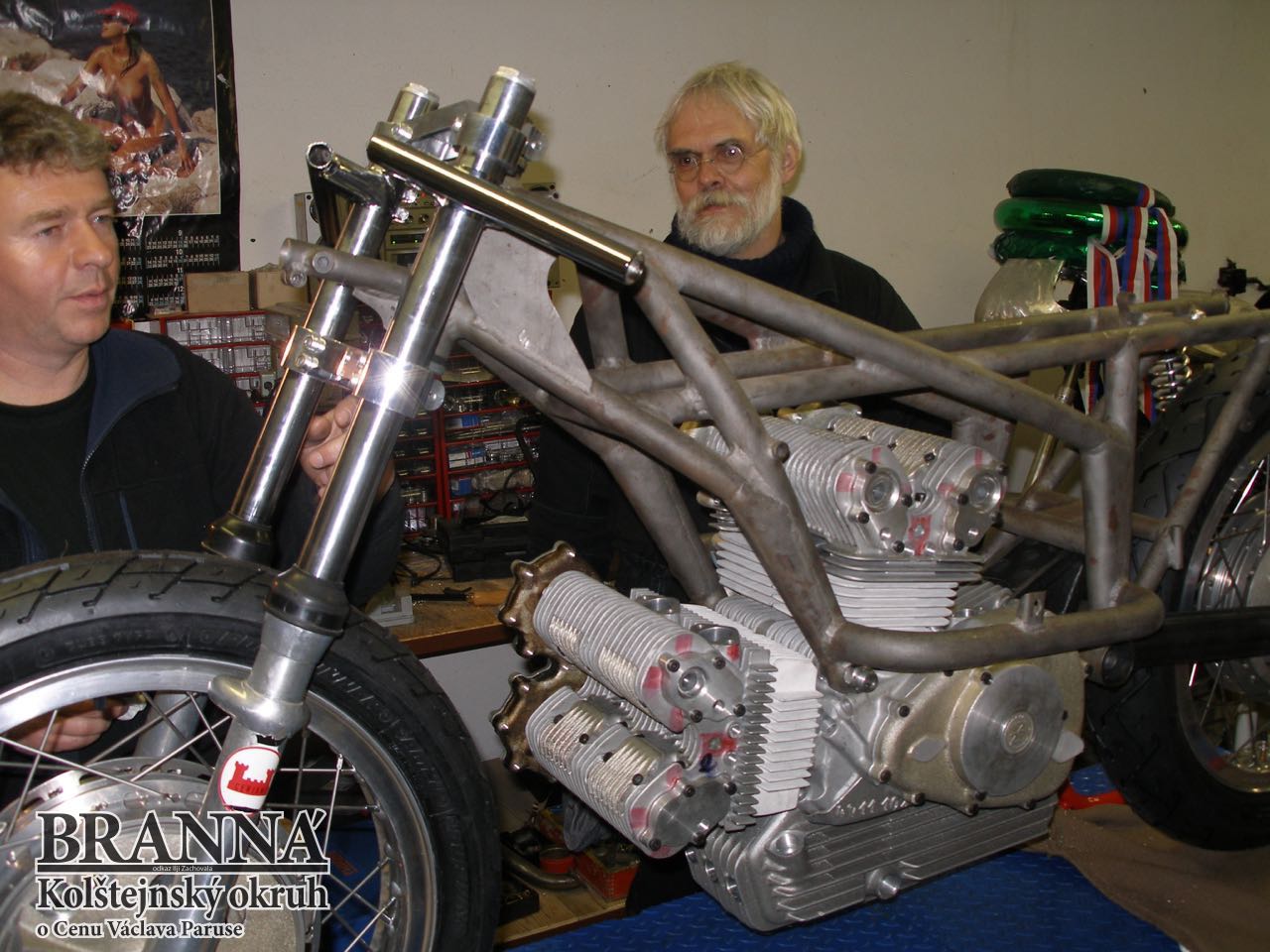
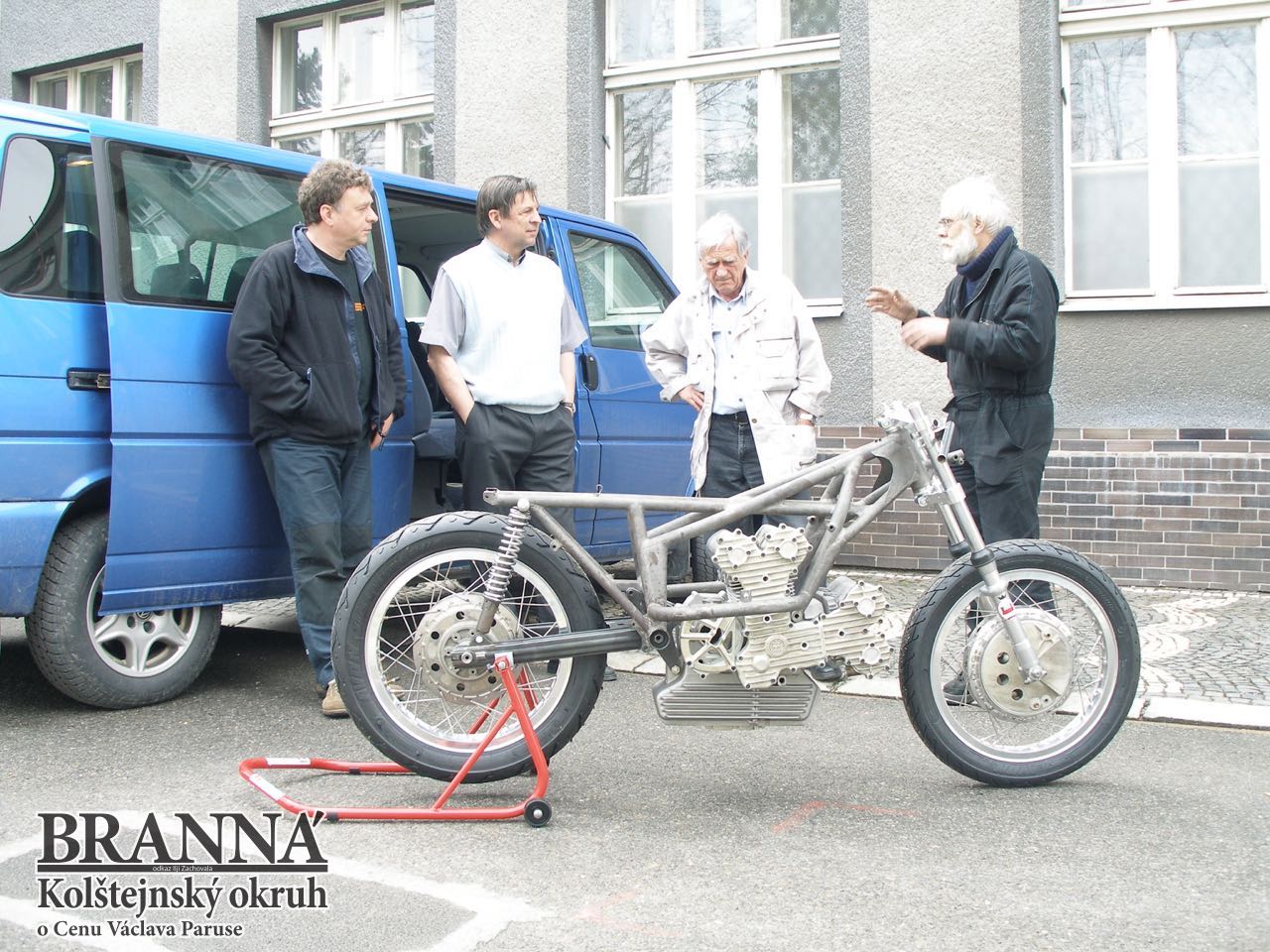
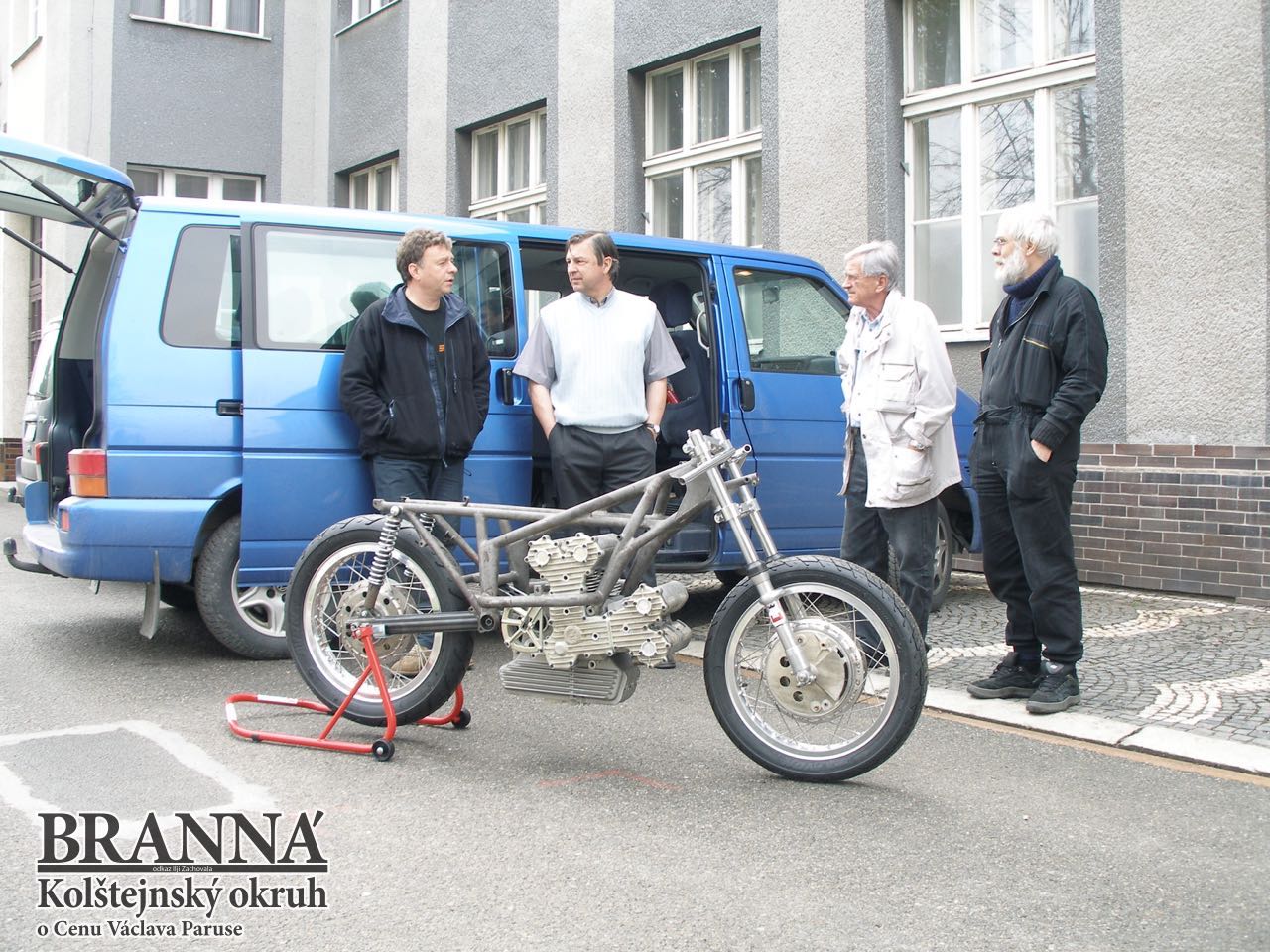
Now, theoretically, there was nothing stopping us from getting to work. However, the practical encounter with reality began, often ending in a complete dead end. The documentation was complete, but too much. It was necessary to choose the last one from many successively drawn variants and then, unfortunately, sometimes in the workshop, to find out that the corrections and repairs from production had not been retroactively entered into the documentation. It was necessary to construct and draw the parts that had to be modified for the 500-volume version. This was work primarily for Vraťa. We divided the work up that way. Ilja also had a relatively large task ahead of him - primarily the production of a rather complex and demanding frame, rear swingarm and other chassis parts. I think that here he applied all his technical skills, craftsmanship, patience in the highest possible way, and with incredible precision and care he did a very high-quality job. Orthodox believers in the originality of veteran cars today paradoxically even reproach us that our chassis is made to a much higher standard of workmanship than the original one from the factory and that it is therefore not completely "kosher". In addition, Ilja also applied his artistic talent, when he created molds for the laminate parts, and the tank model in particular is a quite successful work of sculpture. He played an irreplaceable role as a team psychiatrist, when things were not going well, and it is true that there were times when we would have liked to douse it with gasoline, set it on fire and bury it in the garden. He was simply a great enthusiast of life and perhaps that is why we finally finished it.
I must say that during the production we collaborated with a number of enthusiasts, craftsmen and companies. The lion's share in the implementation also belongs to Olda Prokop, a collector's nestor in the field of racing motorcycles, who completely selflessly and guilelessly lent us some original parts of the original engine from his collection as a model. Wherever we went, the work on this machine was highly regarded and in many cases we managed to get renowned "grease-makers" in the field to cooperate. It was a bit reminiscent of the well-known patriotic event "Nation for itself".
„"So guys, when will it be?" We've been hearing about it for about 8 years. I won't describe the experiences from the first start-up and the ride. It would be like a newlywed telling about their wedding night experiences, and that probably doesn't even fit on paper. To our great regret, Ilja has already lost this experience. Just as he lived life to the fullest, he also drove every time. He overdid it in Hořice and it didn't work out. As he himself said: "Done, swept away!"“
What can we do, nothing! Even though we will only remember Ilya, we take it as if he was riding with us today.
Mirek Tuma